

Now Reading: Smart Homes: Solving Real Problems for Global Investors
-
01
Smart Homes: Solving Real Problems for Global Investors



Smart homes are no longer luxury indulgences. For UHNI and HNI investors, they represent a measurable asset protection strategy—solving energy waste, security vulnerabilities, property damage, and lifestyle fragmentation simultaneously. The global market, valued at about $80–81 billion in 2022, is projected by multiple research providers to exceed $580 billion by 2032, driven by high double-digit CAGR and affluent household adoption across tier-1 markets. Properties with integrated smart systems increasingly command meaningful premiums at resale, sell faster, and reduce operational costs. For sophisticated capital allocators, this is less about gadgets and more about portfolio optimization and wealth preservation.
Why Smart Homes Matter At Scale
Most wealthy individuals own multiple properties across geographies. This fragmentation creates predictable pain points: energy hemorrhage across vacant units, security gaps during seasonal absence, water damage from unmonitored leaks, and the inability to control or verify conditions without being physically present. Traditional homes offer no real-time visibility; they are, in effect, blind assets. Smart homes eliminate much of this friction.
Among affluent households in developed markets, smart technology adoption already exceeds half of the segment and is rising steadily toward saturation. In markets such as India, where NRI capital is reshaping the luxury landscape, penetration remains materially lower, creating a significant opportunity gap for early adopters. The constraint is not cost; it is awareness of value and risk mitigation rather than fascination with novelty.
Energy Inefficiency As Invisible Wealth Drain
An unmanaged property can bleed thousands of dollars annually through inefficient HVAC, lighting, and appliance operation—particularly when homes sit vacant for extended periods. For portfolios of three to five properties, this compounds into tens of thousands of dollars over a decade, before even factoring in rising energy prices and regulatory pressure on inefficient buildings. Smart thermostats, predictive HVAC systems, and occupancy-based lighting regimes can reduce this burden by roughly 40–60 percent, with savings that become more meaningful as property count and size increase.The deeper, less visible impact is valuation.
Properties that demonstrably reduce energy use through integrated systems are perceived as more future-proof and can attract appraisal or buyer premiums. In practice, this can translate into tens or hundreds of thousands of dollars of incremental value on multi-million-dollar assets, especially in markets where sustainability is priced into rents and capital values.
Security As Non‑Negotiable
For ultra-high-net-worth individuals, the primary concern is not convenience; it is control and security at a distance. A penthouse in Mumbai left empty through the monsoon, a Dubai villa used intermittently, or a London townhouse vacant during the summer, all pose insurance and security risks. Traditional locks, stand-alone cameras, or on-site staff offer only partial comfort and often lack verifiable audit trails.
Smart security systems—integrated CCTV, biometric access, perimeter and motion sensors, and remote lock management—create persistent situational awareness. They meaningfully reduce exposure to break-ins and unauthorized access and are increasingly recognized by insurers. In many markets, professionally installed, monitored smart security systems can attract insurance premium reductions; over a multi-year holding period, that becomes a non-trivial contribution to total return while reducing tail risk on catastrophic events.
For lenders and institutional buyers, robust, documented security hardens a property as collateral. That, in turn, can influence financing terms and widen the pool of end-buyers who consider such homes institutionally investable assets rather than purely lifestyle purchases.
Property Damage Prevention: The Overlooked ROI
Water intrusion, undetected leaks, mold from humidity swings, and equipment failures are among the most common—and costliest—sources of luxury property claims. In high-value homes, a single major incident can escalate into six- or seven-figure restoration bills, downtime, and reputational risk if the property is part of a branded portfolio or hospitality-linked asset.
Smart leak sensors, always-on temperature and humidity monitoring, and connected mechanical systems make it possible to detect incidents early, before they become claims. Predictive maintenance, where systems flag abnormal behavior in HVAC or pumps, further reduces the likelihood of outages and damage. The financial impact lies less in incremental yield and more in avoided loss and lower volatility—a factor that sophisticated investors and family offices increasingly value.
Lifestyle Convenience That Commands A Premium
The headline convenience features of smart homes—voice-controlled lighting, automated blinds, scene-setting—are often marketed as lifestyle luxuries. For serious investors, the real convenience is higher up the stack: centralised control of multiple homes, the ability to prepare a property before arrival, and seamless guest or staff access management without physically being on site.
A portfolio interface that allows an owner or asset manager to view and adjust security, climate, and key systems across several homes—whether in Mumbai, Dubai, London, or Singapore—transforms how a property portfolio is managed. It reduces the need for constant local oversight and makes it far easier to standardise experiences and policies across geographies. Buyers increasingly recognise this as a premium feature and are willing to pay for the assurance and efficiency it brings.
The Investment Case: Why Capital Is Following Smart Infrastructure
Research providers tracking the global smart home market show a steep growth trajectory through the next decade, with the market expanding from tens of billions of dollars in 2022 into the high hundreds of billions by 2032, driven by roughly low‑20s-percent compound annual growth. Affluent and younger, tech‑comfortable households are the leading edge of this curve.
Properties that arrive on the market with properly integrated smart systems tend to sell faster than their non‑smart peers, reflecting buyers’ preference for future‑ready assets. In competitive urban luxury segments, that speed premium can be the difference between a smooth exit and a protracted discount‑driven sale. Institutional buyers, relocation clients, and global families increasingly filter for homes with documented automation and security infrastructure. That expanded buyer pool supports both liquidity and pricing.
NRI Capital And Indian Luxury: An Underpenetrated Gap
Independent consultancies and brokerages tracking Indian real estate expect NRI investment to run into the tens of billions of dollars annually, with luxury housing accounting for a meaningful share. Yet a sizable portion of new and existing inventory, even at the upper end, still lacks robust smart infrastructure, relying instead on basic video door phones or stand‑alone devices.
This gap between capital sophistication and property specification is where early movers can unlock arbitrage. Integrating a recognised automation and security stack into a prime Mumbai or Bengaluru residence can lift perceived quality to international standards, making the property more attractive not only to domestic buyers but also to returning NRIs and international capital. Retrofitting existing holdings may involve mid‑five‑figure outlays, but the resulting uplift in perceived and realised value can be several multiples of that cost over the asset’s life.
Sustainability As Capital Preservation
Sustainability is transitioning from marketing label to financial risk factor. Regulators in Europe, parts of Asia, and select US states are tightening standards around building performance. Over time, homes that cannot demonstrate efficient operation may face higher running costs, reduced financing flexibility, or even regulatory penalties. Smart systems are not a substitute for good building fabric, but they make efficiency visible and controllable in ways legacy systems do not.
Institutional investors allocating to residential or mixed‑use portfolios increasingly favour assets that combine location and design quality with measurable efficiency. Smart‑equipped luxury homes sit at that intersection, making them candidates for inclusion in portfolios that once might have focused only on commercial buildings. For a high‑net‑worth individual, aligning personal holdings with institutional standards is a form of pre‑emptive de‑risking.
The Global Landscape: Where Smart Homes Are Redefining Expectations
India
In India, smart home features are moving from novelty to expectation in the upper segments of Mumbai, NCR, Bengaluru, and select emerging hubs such as GIFT City. Developers of premium projects now routinely advertise app‑based controls, integrated security, and energy‑management features, though sophistication varies widely across schemes. For NRIs, the ability to monitor and manage a property remotely adds reassurance to what is often a long‑distance asset.
UAE
In the UAE, climate control, shading, and air‑quality management are particularly important given the harsh environment. Smart HVAC and shading systems offer tangible cost and comfort benefits in Dubai and Abu Dhabi, and are increasingly viewed as part of the minimum specification for serious luxury homes. Here, energy savings and liveability sit alongside security as the main drivers of adoption.
Singapore
In Singapore, adoption is driven by density, high real estate values, and a deeply tech‑integrated urban environment. Smart systems are often woven into the building fabric of new condominiums and integrated developments. For investors, the differentiator is less whether a home is “smart” and more how well that smart infrastructure is executed, maintained, and interoperable with emerging platforms.
UK and Europe
In the UK and parts of Europe, energy price volatility and policy pressure around carbon have accelerated retrofits. Historic and prime properties are being upgraded with discreet smart systems that optimize heating, lighting, and security without disturbing heritage fabric. Buyers increasingly look for homes that combine character with contemporary performance—and are wary of homes that require full‑scale modernisation at their own expense.
US
In the US, smart home penetration among affluent households is already high, especially in coastal metros and tech‑driven markets. Here, sophisticated buyers treat basic smart functionality as standard, not as a selling point. Differentiation comes from execution quality, privacy protections, integration depth, and the ability to manage complex estates from unified platforms.
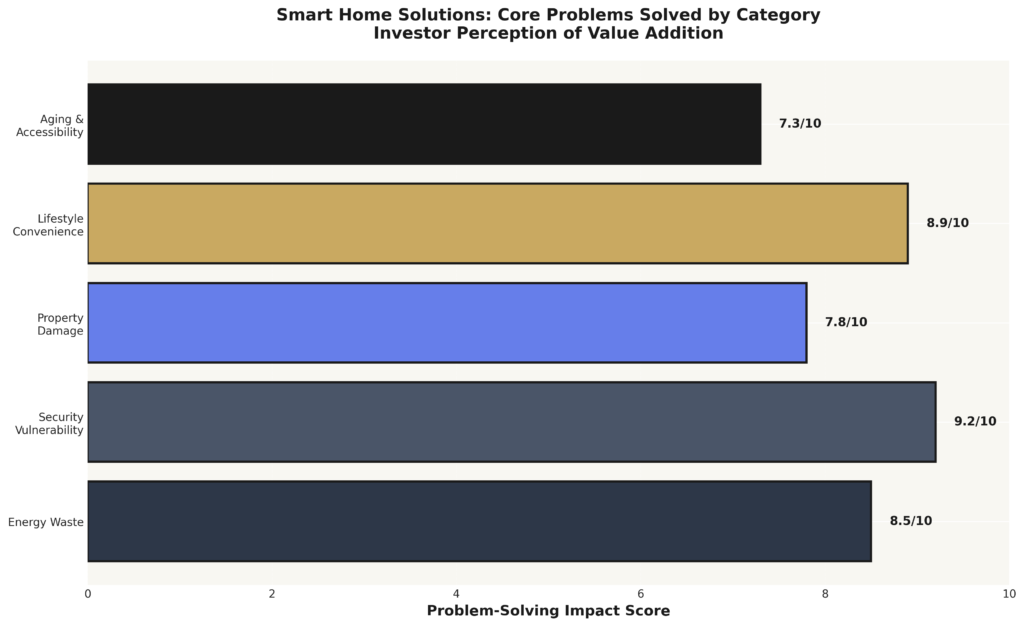
The Five Core Problems Smart Homes Solve: An Investor’s Lens
Energy Waste
Unoccupied or lightly used properties frequently operate as though fully occupied, with HVAC and lighting running out of habit or neglect. Smart systems tie energy use to presence, time, and climate, tightening the link between cost and actual use. For high‑value homes in warm climates or large villas with expansive conditioned space, the delta is especially pronounced.
Security Vulnerability
Conventional locks and DVR‑based cameras offer limited deterrence and post‑factum documentation. Integrated systems bring live alerts, remote intervention, verifiable logs, and the ability to coordinate with security providers. For owners who travel extensively, that continuity is a key intangible: the asset is never fully “dark”.
Property Damage
Water leaks, frozen pipes in cold markets, and latent humidity problems in coastal cities can all compromise finishes and structure. Discreet sensors and connected mechanical systems enable early intervention rather than costly remediation. For portfolios, this is a quiet but powerful stabiliser of long‑run returns.
Lifestyle Fragmentation
Managing access for family, guests, staff, and service providers across multiple homes is administratively taxing. Smart locks, access schedules, and unified control interfaces reduce friction and the reputational risk of mishandled guest experiences. This is particularly relevant for investors who use certain properties for both personal and semi-commercial or hospitality purposes.
Aging and Accessibility
As wealth holders age, or as multi-generational households share space, accessibility and safety become central. Voice control, programmable scenes, automated doors, and unobtrusive monitoring can extend the period during which a home remains practical and safe. That reduces the pressure to trade out of beloved properties purely for functional reasons.
Tips For Sophisticated Investors
- Consider timing upgrades before marketing an exit. A well‑documented smart system can help reposition an older property as current and reduce price negotiations.
- Standardise on one or two recognised platforms across a portfolio to avoid fragmentation and to make management easier for family offices and property managers.
- Involve insurers and lenders early when planning upgrades; formal recognition of systems can enhance the economic case through lower premiums or improved financing.
- Budget not only for installation but for ongoing maintenance and software updates; an unmaintained system quickly becomes a liability rather than an asset.
- Preserve comprehensive documentation—warranties, diagrams, specifications—to hand over at sale; it increases buyer confidence and underpins claims of premium positioning.
Risks And Contrarian Perspectives
There are cases where extensive smart upgrades may not be justified. In politically unstable or weakly regulated markets, capital preservation may hinge more on macro‑risk than on marginal efficiency gains. In such contexts, minimalist, portable solutions may be more rational than deeply integrated systems.
Even in prime markets, overspecification can be a risk. Ultra‑prime bespoke homes with highly customised, proprietary systems may face future compatibility and support issues that put off buyers. Technology also ages faster than architecture; investors should assume that systems will require meaningful refreshes over a five‑ to seven‑year horizon and should plan capital expenditure accordingly. Privacy and data‑security concerns add another layer: poorly configured systems can create new vulnerabilities even as they close others.
FAQs
Do smart homes actually increase property value?
Buyers in major luxury markets often pay a premium for homes with well‑integrated, documented smart systems, particularly where those systems demonstrably reduce running costs and enhance security. The combination of better liquidity, faster sales, and perceived future‑proofing typically underpins this uplift.
What is the realistic cost of smart‑equipping a luxury home?
For a high‑end single residence, integrated automation, security, and energy management can range from low‑ to mid‑five‑figures in US dollar terms, depending on size and complexity. New‑build integration is generally more efficient than retrofits, both in cost and in aesthetic impact.
Is smart home infrastructure now expected in all luxury properties?
In mature markets such as the US and parts of Europe and Asia, buyers increasingly treat basic smart features as standard, while more sophisticated integration differentiates top‑tier properties. In emerging markets, adoption is growing quickly in the luxury segment but is not yet universal.
Which platforms are most attractive from a resale perspective?
Systems from established players with broad ecosystems and support networks—such as leading automation and lighting control brands—typically inspire more confidence among buyers and valuers. Exotic or fully proprietary systems can raise concerns about maintainability and long‑term compatibility.
Over the next decade, Indian luxury real estate is likely to sit alongside Dubai, Singapore and London not as a rival, but as the home‑market pillar in a wider architecture of wealth. The data from 2024–25 — premium homes dominating new sales, ultra‑luxury deals holding their own, UHNWIs increasing both their real‑estate allocation and their willingness to rent out second homes — points to a maturing, not frothing, market.
The quiet institutionalisation of leasing, through build‑to‑rent, SM‑REITs and professional operators, offers Indian and global investors a way to hold rupee assets with the sort of cash‑flow visibility they expect elsewhere.
Conclusion
Over the next cycle, the distinction between a “beautiful home” and a “serious asset” will sharpen. For UHNI and HNI investors, smart infrastructure is emerging as one of the quiet lines of demarcation. It turns properties from static holdings into responsive, measurable components of a portfolio—reducing invisible leakages, tightening risk, and aligning personal assets with institutional standards.
For NRIs and global families with exposure to India, the UAE, the UK, Singapore, and the US, the opportunity lies in moving ahead of the adoption curve in markets where “smart” is not yet universally priced in. That window will not stay open indefinitely. For those looking to future‑proof their holdings, this is the moment to audit portfolios, retrofit selectively, and, where appropriate, embed smart criteria into new acquisitions. The next conversation with your advisor should not be “Should I do this?” but “Which assets should we optimise first, and to what depth?”
YouTube Resources
Free Resources To Download
Smart Homes: Key Points Summary
Related reading: Smart home investment guide — ROI, system tiers, and what to look for when buying — NRI real estate investment guide — legal framework, financing, and market selection.
Smart Home Automation Systems — What to Evaluate
For global investors evaluating smart home automation as part of a luxury property purchase, the core systems to understand are whole-home control platforms (Crestron, Lutron, Control4), smart home security integration (perimeter, access control, video surveillance), and environmental automation (climate, lighting, shading). A smart home automation system installation in a ₹5Cr+ property typically runs 2-5% of property value for a professionally specified whole-home setup. The smart home automation devices market in India has grown 30% YoY since 2023 driven by HNI/UHNI adoption.
For a deeper look at ROI on these systems across Indian luxury properties, see our smart home investment guide.

Related Posts

Stay Informed With the Latest & Most Important News
Previous Post
Next Post