

Now Reading: How Scarcity Really Works in India’s Luxury Housing Market
- 01
How Scarcity Really Works in India’s Luxury Housing Market

Why This Moment in Indian Luxury Property Matters
In the first half of 2025, sales of homes priced above ₹4 crore surged 85% year-on-year across the top seven cities, with approximately 7,000 units absorbed. Yet this momentum is not simply a function of demand. Developers — from DLF in Gurugram to Lodha in Mumbai — are deliberately constraining supply, phasing launches in tight tranches, and constructing scarcity narratives that sustain pricing power across cycles. The country’s UHNI population reached 13,600 in 2024, growing at 6% annually and projected to rise 50% by 2028.
NRI capital flows into Indian real estate are approaching $16.3 billion in 2025. Against this backdrop, the psychology of scarcity — both organic and orchestrated — has become the defining mechanism through which India’s most consequential residential transactions are priced, positioned, and closed. For sophisticated allocators, understanding this dynamic is no longer optional; it is the difference between strategic entry and overpaying for narrative.
How India’s Luxury Homes Now Sit in a Global Capital Chessboard
A Structural Rebalancing, Not a Cycle
The expansion of India’s luxury housing market is rooted in forces more durable than post-pandemic enthusiasm. India now hosts 378,810 millionaires with aggregate wealth of $1.5 trillion, an 8.8% increase in 2024 alone. The billionaire count reached 191, a 12% jump from the prior year. Meanwhile, 103 Indian corporates raised a record $19.54 billion through IPOs in 2025, minting a new generation of founders and CXOs entering the ₹10 crore-plus housing segment for the first time.
This is not merely an Indian story. It sits within a broader reconfiguration of global wealth flows. While China’s UHNI population grew by just 2% in 2024, India’s expanded by 6% — and is forecast to outpace the global average through 2028. Approximately 14% of Indian UHNIs already own property abroad, with average international investments exceeding ₹12 crore, primarily in Dubai, London, and Singapore. The question for this cohort is no longer whether to allocate to Indian luxury real estate, but how to access it before manufactured scarcity narrows the window further.
How India Stacks Up Against Dubai, London, and Singapore
India’s residential rental yields — average 3–4% in prime micro-markets. Capital appreciation in prime Indian cities holds steady at 7–8% annually. Combined with a favourable rupee dynamic for dollar-earning NRIs and improving regulatory transparency via RERA, India’s luxury segment offers a risk-return profile that few comparable global markets can match.
The Architecture of Scarcity
How Developers Curate Supply
The most consequential shift in India’s luxury market over the past three years is not on the demand side — it is in how supply is managed. Top builders including DLF, Prestige, Sobha, Lodha, Godrej, and Tata Housing have consciously reduced exposure to affordable projects, focusing instead on fewer, high-margin luxury launches. In Gurugram, DLF has intentionally limited the number of ultra-luxury apartments, creating a scarcity-driven premium that competitors like M3M and Smartworld have replicated along Golf Course Extension Road.
This is not organic scarcity alone. Prime urban land is genuinely finite — and prohibitively expensive — in Mumbai’s Worli and Bandra, or Gurugram’s Golf Course Road. But developers amplify this constraint through deliberate phasing: releasing inventory in curated tranches, calibrating price escalation across phases, and using waitlists and by-invitation sales events to construct urgency. The result is a market where pricing power resides firmly with the developer, not the buyer.
Supply-Demand Tension in Numbers
The data reveals the tension clearly. In Q1 2025, luxury home sales (₹4 crore and above) rose 28% year-on-year to approximately 1,930 units across seven cities. Delhi-NCR commanded a 49% share, with Mumbai at 23%. But in Mumbai, unsold luxury inventory (above ₹2.5 crore) rose 36% year-on-year to 8,420 units in Q1 2025 — the first increase since 2022 — driven by aggressive new launches (16,480 luxury units in 2024 alone). Delhi-NCR, by contrast, saw a 30% decline in unsold inventory, reflecting tighter supply management and faster absorption.
The ultra-luxury overhang for properties priced between ₹20–50 crore sits at 17.1 quarters — over four years — suggesting that manufactured scarcity operates most effectively at the ₹4–15 crore range, while the very top of the market faces genuine absorption challenges.
What the Numbers Tell Serious Capital
The ₹10 Crore Club
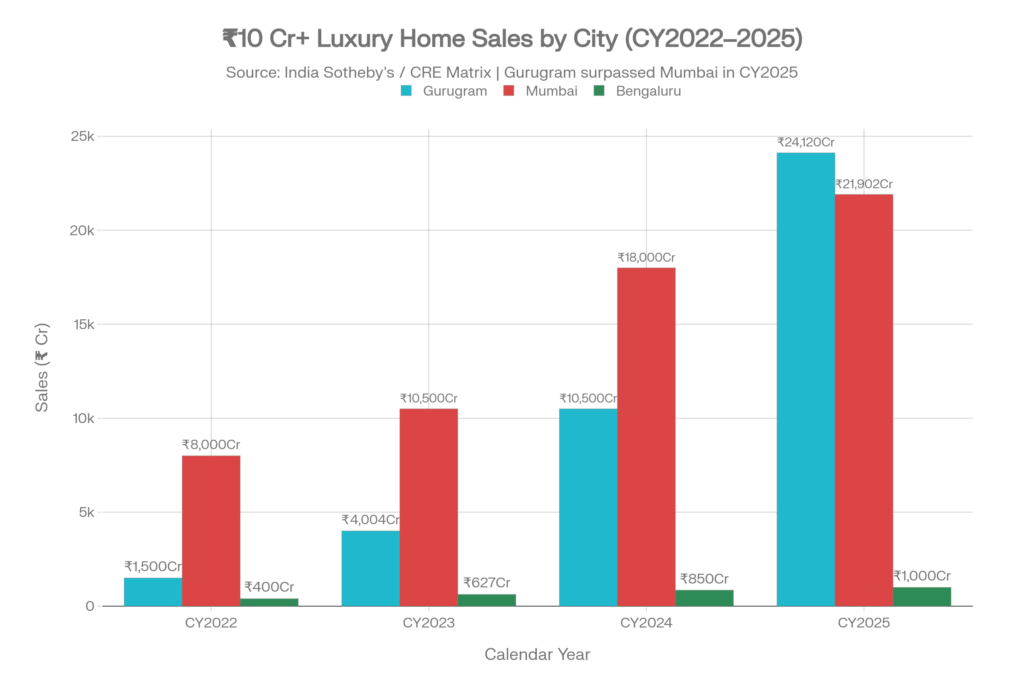
The ultra-luxury tier — homes priced at ₹10 crore and above — is where scarcity dynamics are most visible and most effective. Gurugram recorded ₹24,120 crore in transactions in this segment during calendar year 2025, with 1,494 homes sold — the highest ever in a single year. Transaction values surged six-fold from ₹4,004 crore in CY2023. Mumbai followed at ₹21,902 crore. Bengaluru’s luxury market crossed ₹1,000 crore in FY2024–25 for the first time, with 59% year-on-year growth driven by CXOs and startup founders.
Why These Homes Are About More Than Returns
When a Home Becomes an Anchor
For many Indian UHNIs and NRIs, a luxury home in Mumbai, Bengaluru, or Goa is not primarily an investment — it is an anchor. It is the place where ageing parents live comfortably, where children return during summers, where a family’s presence in India is physically manifest even when the principal earner resides in San Francisco, Dubai, or Singapore.
Over 40% of Indian UHNIs have now established family offices to manage wealth, succession planning, and philanthropy. Real estate — particularly trophy residential assets — sits centrally within these structures. It serves as a tangible, illiquid counterweight to volatile portfolio holdings: a hedge not against inflation alone, but against the existential uncertainty of being geographically dispersed.
The post-pandemic shift reinforced this. Demand for larger configurations — 3BHK and above, study rooms, wellness amenities, integrated work-from-home infrastructure — surged beyond the capacity of traditional affordable products. In Bengaluru, apartments between 5,000–7,000 sq ft now dominate the luxury conversation, with buyers seeking spatial generosity that mirrors the homes they inhabit abroad. In Mumbai, 70% of primary luxury sales in H1 2025 were apartments between 2,000–4,000 sq ft. The luxury home has become a lifestyle declaration — a commitment to rootedness in an age of mobility.
Case Studies
Mumbai: Worli’s Quiet Dominance
Worli retained its position as Mumbai’s most preferred luxury micro-market in H1 2025, contributing 22% of primary sales value in the ₹10 crore-plus segment. Mumbai’s overall ultra-luxury sales reached ₹14,750 crore in H1 2025, an 11% increase over the prior year. Notably, the ₹20–40 crore sub-segment grew by 138% compared to H1 2022, signalling that the wealthiest cohort is increasing allocation despite elevated pricing. Bandra West recorded 192% growth in sales value, while Tardeo surged 254%. The buyer profile skews toward the 45–65 age group, though those above 65 now represent 15% of transactions — a legacy-planning cohort making intergenerational moves. Source: India Sotheby’s International Realty / CRE Matrix H1 2025 Report.
Gurugram: Manufactured Scarcity at Scale
Gurugram’s transformation from a satellite city to India’s leading ultra-luxury hub is perhaps the most instructive case study in curated scarcity. Sales of ₹10 crore-plus homes surged from 155 units in CY2023 to 1,494 units in CY2025 — a nearly tenfold increase. Dwarka Expressway alone recorded a 2,079% jump in transaction value, from ₹383 crore to ₹8,347 crore. This momentum was not accidental; it was engineered through controlled inventory releases, infrastructure-linked pricing narratives (particularly around the Delhi-Mumbai Expressway and Rapid Metro extensions), and a deliberate pivot from volume to value by developers including DLF, M3M, and Smartworld. Source: India Sotheby’s / CRE Matrix CY2025 Report; Knight Frank India.
Goa: The Lifestyle Allocation
Goa’s luxury real estate market presents a different scarcity dynamic — one driven by geography, regulation, and cultural cachet rather than developer-led phasing. Property prices surged 66.3% year-on-year. North Goa locales such as Anjuna, Assagao, and Vagator saw a 28% year-on-year rise in villa prices in early 2024. For NRIs and HNIs from Mumbai, Bengaluru, and Pune, a Goa villa represents an emotion-led allocation — part lifestyle hedge, part legacy asset, part statement of arrival. The scarcity here is genuine: limited coastal land, environmental clearance constraints, and growing demand from a global buyer pool that views Goa as India’s answer to Ibiza or Bali, but with deeper personal resonance. Source: Savills India; Business Today.
Where the Story Gets Complicated
Questions the Most Careful Buyers Are Asking Themselves
The luxury housing narrative in India is compelling, but it is not without friction. Several structural risks merit honest assessment.
Regulatory and taxation complexity remains a persistent deterrent for NRI and OCI investors. India’s tax treatment of property income — including TDS obligations, capital gains provisions for non-residents, and the interplay between DTAA benefits and local stamp duties — creates compliance friction that can erode net returns, particularly for investors accustomed to the relative simplicity of Dubai or Singapore structures.
Liquidity in ultra-luxury assets is genuinely thin. The overhang for properties priced between ₹20–50 crore sits at 17.1 quarters nationally. In Hyderabad, inventory overhang has reached 26 months. Even in Mumbai, where demand is deepest, the secondary market for ultra-luxury homes remains shallow and price-sensitive. Investors should calibrate holding periods accordingly — this is not a liquid asset class.
Overconcentration risk in marquee micro-markets is emerging. When 90% of luxury launches concentrate in Delhi-NCR, Mumbai, and Hyderabad, and when individual corridors like Dwarka Expressway attract ₹8,000+ crore in a single year, the risk of localised oversupply and price correction in specific micro-markets becomes material. Discernment — not momentum — should guide allocation.
A contrarian note: The 36% rise in Mumbai’s unsold luxury inventory in Q1 2025 is an early signal that developer exuberance can outrun even robust demand. Not all scarcity is manufactured wisely. Some of it reflects mispricing.
FAQ
Is Indian luxury real estate a good investment for NRIs in 2025?
Indian luxury housing offers a combination of 7–8% annual capital appreciation, rental yields of 3–4% in prime markets, and improving regulatory transparency through RERA. NRIs now account for approximately 20% of property purchases, and investment flows are projected to reach $16.3 billion in 2025. However, returns vary significantly by micro-market and holding period. Due diligence on developer track record, RERA compliance, and local demand dynamics is essential.
Why are luxury home prices rising despite economic headwinds?
The rise is driven by a convergence of genuine land scarcity in prime urban locations and deliberate supply management by developers, who are phasing launches and prioritising high-margin luxury projects over volume. India’s UHNI population is growing at 6% annually — faster than China’s — creating persistent demand at the top. Additionally, IPO-driven wealth creation ($19.54 billion in 2025) is generating a new buyer cohort.
Which Indian cities offer the best luxury real estate opportunities?
Gurugram leads in ultra-luxury transaction value (₹24,120 crore in CY2025), driven by infrastructure expansion and controlled supply. Mumbai remains the deepest market with established legacy micro-markets like Worli and Bandra. Bengaluru is emerging strongly, with luxury sales crossing ₹1,000 crore for the first time in FY25, led by tech founders and CXOs. Goa represents a lifestyle-driven allocation with price appreciation and strong rental yields.
What are the key risks of investing in Indian luxury property?
Primary risks include regulatory and tax complexity for non-residents, thin liquidity in the ₹20 crore-plus segment (17.1-quarter overhang nationally), concentration risk in a few micro-markets, and the possibility that developer-led scarcity may mask localised oversupply. Investors should plan for 5–7 year holding periods and prioritise completed or near-completion inventory from established developers.
What This Decade Could Mean for Indian Luxury Homes
Indian luxury real estate is not a trade; it is an architectural decision within a broader wealth framework. The forces sustaining this market — India’s wealth velocity, diaspora capital repatriation, generational succession, and the finite nature of prime urban land — are structural rather than speculative. But the most important insight for global allocators is not that demand is strong. It is that supply is being curated with increasing sophistication, and the investors who understand this mechanism will allocate more effectively than those who simply follow headline growth.
Patience, selectivity, and an understanding of developer incentives will separate capital that compounds from capital that merely participates. The next decade will reward those who treat Indian luxury housing not as a market to enter, but as a position to build — carefully, across cycles, and with the quiet confidence of a thesis that does not require validation from the crowd.
YouTube Resources
Related Posts



Stay Informed With the Latest & Most Important News
Previous Post
Next Post








Advertisement