

Now Reading: Investment Property in Goa: 8 Costly Mistakes First-Time Investors Make (and How to Avoid Them)
-
01
Investment Property in Goa: 8 Costly Mistakes First-Time Investors Make (and How to Avoid Them)

Investment Property in Goa: 8 Costly Mistakes First-Time Investors Make (and How to Avoid Them)



Goa is one of the most attractive Indian real estate markets of the decade — and one of the easiest to lose money in if you walk in with city instincts. The state’s title structure, its CRZ regulations, the Communidade land system, the gap between brochure pricing and transacted pricing, and the operational reality of running a holiday-let from 1,500 km away all combine into a market where the same seven or eight mistakes are repeated by buyer after buyer. This guide is the honest pre-mortem we wish every new investment property in Goa buyer was handed at the start of their search.
Below are the eight mistakes that account for the bulk of disputes, legal cases, distressed resales and quiet regret we’ve seen in the Goa market in 2026 — and the specific fixes that take each of them off the table before you commit. We’ve deliberately not quoted per-square-foot prices: the gap between advertised and transacted is still wide enough that a number here would mislead more than it would inform.
Table of Contents
Why Goa Investment Property Has Its Own Failure Modes

The mistakes Indian buyers make on a Mumbai flat or a Bengaluru apartment don’t map cleanly onto a Goa investment property. Goa carries three legacy structures that buyers from outside the state regularly underestimate:
- The Portuguese-era title chain. Many parcels still trace through the 1867 Civil Code, Inventário proceedings, and a long list of family heirs — none of which look like a clean Indian title chain on first inspection.
- The Communidade land system. Sizeable parts of village land in Goa sit in Communidade (community-held) tenure, which constrains what can be sold, leased and built without specific clearances.
- The CRZ envelope. Goa’s coastline is mostly under Coastal Regulation Zone notifications — CRZ-I, CRZ-II, CRZ-III and the relevant No Development Zone widths — and getting this wrong is the fastest way to buy a plot you can’t legally build on.
Add to that the practical reality that most buyers are remote, the local records span multiple scripts (English, Konkani in Devanagari, Marathi, Portuguese-era documents), and the regulator landscape spans RERA Goa, the Town and Country Planning Department, the village panchayat, the District Collectorate and the Communidade itself — and you have a market where the failure modes are structural, not random.
Mistake 1 — Letting the Builder’s Lawyer Act for Both Sides
This is the single most common, single most damaging mistake on a property investment in Goa. The developer’s panel lawyer drafts the agreement, runs the title search, holds the documents and “explains” the clauses to you. The lawyer’s loyalty is structurally to the developer who pays them on every closing — not to you on one.
Fix: Engage your own independent Goan attorney-at-law before you sign anything beyond the booking form. Their fee is a tiny fraction of the consideration. Their loyalty is unambiguous. They’ll read the agreement clause-by-clause, raise the corrections in writing, and you’ll sign only the corrected version. If a developer pushes back on letting an independent lawyer review the agreement, that resistance is itself the answer to whether you should buy from them.
Mistake 2 — Skipping the 30-Year Title Search
A clean current Form I and XIV tells you only what the position is today. A 30-year title search establishes the chain — every transfer, partition, inheritance, gift, mortgage and release that brought the parcel from its 1990s owner to the current seller. In Goa, that chain often passes through Inventário proceedings, and a missed heir signature anywhere in the chain is a defect that surfaces years later, usually at the worst possible time.
Fix: Insist on a written title opinion from your lawyer covering at least the prior 30 years, with an explicit conclusion on marketability and any open issues. Pair it with a recent encumbrance certificate from the Sub-Registrar’s office. If your lawyer can’t give you a clean opinion in writing, the title isn’t clean — regardless of what the developer’s salesperson tells you.
Mistake 3 — Buying a Plot That Can’t Legally Be Built On
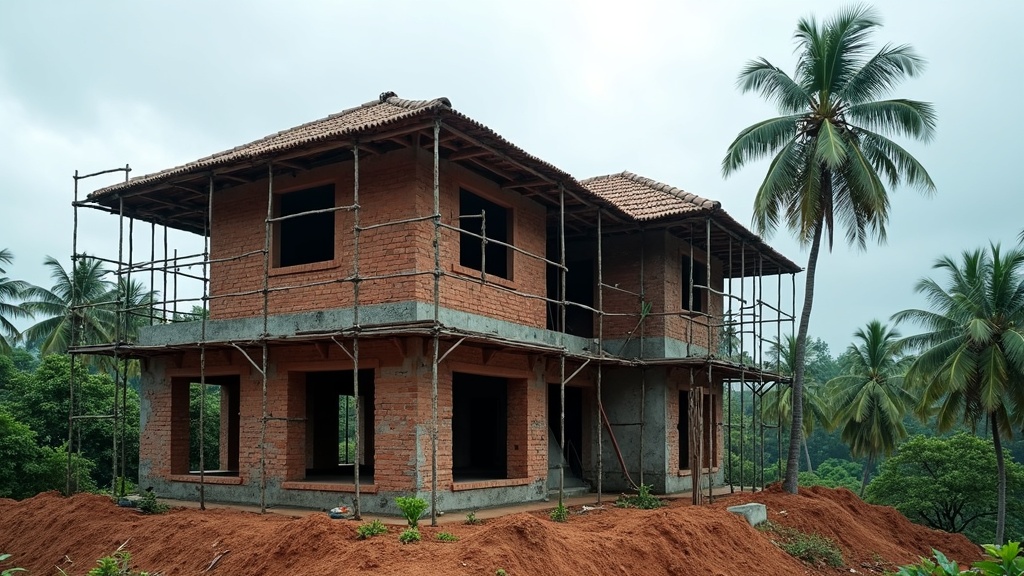
“NA plot” and “settlement zone” get used casually in Goa listings. They’re not always accurate. A parcel may still be classified as agricultural land in the latest survey, may sit in CRZ-III with an applicable No Development Zone width that swallows the building envelope, or may be in a zone where the Floor Area Ratio is too low to support a sensible villa or apartment.
Fix: Before you commit, pull and verify:
- The current Form I and XIV — does it show the parcel as “kher” (settlement) or another non-buildable category?
- The Conversion Sanad — has the land been formally converted from agricultural to settlement use, and for what permissible use?
- The Regional Plan and Outline Development Plan zoning — does the parcel fall in a zone that allows residential / commercial / hospitality development at the density you intend?
- The CRZ classification and applicable NDZ width if the parcel is anywhere within the coastal envelope — and remember, “coastal” can extend significantly inland along rivers and tidal creeks.
- The applicable FAR / FSI — does the buildable envelope actually support the structure you have in mind?
The clearest single document is the Town and Country Planning Department’s zoning confirmation, available via the Regional Plan portal and confirmable in person at the relevant district office. Your lawyer should pull both.
Mistake 4 — Underestimating the Communidade Question

If any part of the parcel — or the access road, or the boundary — touches Communidade land, you’re dealing with a legal owner that’s neither the seller nor a registrable individual: it’s a village community land trust governed by its own code. Communidade clearances aren’t optional, and they can’t be retro-fitted after registration.
Fix: Have your lawyer specifically certify whether the parcel, its access and its boundary have any Communidade interface, and if yes, what clearances are required, what timeline they typically take in that taluka, and whether they are currently in place. “No Communidade involvement” is a perfectly acceptable answer — but it has to be a confirmed answer, not an assumed one.
Mistake 5 — Ignoring the Holiday-Let Licence and Society Tenancy Restrictions
An overwhelming share of Goa investment cases assume short-let or Airbnb-style yield. The reality is that a sustainable short-let operation in Goa requires a stack of clearances, each with its own gatekeeper:
- A registered tourism unit licence from the Department of Tourism (where applicable for the format).
- Society / association NOC for short-let tenancy — many gated communities and apartment complexes now expressly prohibit short stays and have enforceable bylaws.
- Police verification for every guest stay.
- GST registration if your turnover crosses the threshold.
- Local panchayat trade licence in some talukas.
Buying a property whose society bylaws prohibit short-let — and then underwriting the purchase on short-let yield — is a structural mistake no amount of property-management skill will fix.
Fix: Before signing, read the society bylaws (or the project’s covenants for a gated villa community), confirm in writing with the developer or existing society whether short-let is permitted, and if it is, line up the tourism unit licence pathway with your lawyer. If your yield case depends on short-let and the society’s answer is “no”, the yield case has to be rebuilt around long-let — typically a 30–40% lower gross yield.
Mistake 6 — Confusing Brochure Yield with Realised Yield
The brochure quotes a peak nightly rate, multiplies by 365, and arrives at a headline gross. The real number — what actually lands in your bank account in a typical year — is the brochure number minus monsoon-season near-vacancy, minus shoulder-season discounting, minus platform commissions, minus property-management fees, minus utilities, minus maintenance, minus the society maintenance levy, minus the GST you actually charge guests, minus the income tax you pay on the net.
Fix: Underwrite to a realistic occupancy assumption. For coastal Goa short-let, that’s typically 45–60% annual occupancy for well-managed properties in their peak years, often lower for newer properties still building reputation. Deduct platform commissions (around 15%), management fees (20–25% of net), maintenance and utilities, and look at the net-yield number — not the gross. If the realistic net-yield case still works, you’re looking at a real investment. If only the gross case works, you’re looking at a brochure.
Mistake 7 — Skipping the Builder NOC Stack on Resale Inventory
If you’re buying a resale apartment in a Goa project, the developer’s NOCs and the society’s NOC are still your problem, not just the prior owner’s. Specifically: the builder’s NOC for transfer (often subject to a transfer-fee schedule), the society’s NOC confirming all dues are cleared, the maintenance corpus position, any pending capital-repairs assessments, and the status of common-area construction completion versus what the original brochure promised.
Fix: On a resale, ask for the most recent society AGM minutes (last two years), the maintenance ledger position for the unit, any capital-call resolutions in the pipeline, and the developer’s transfer-fee schedule. A clean society with low arrears and disclosed capital plans is worth a modest premium over a cheap unit in a dysfunctional society.
Mistake 8 — Buying Without a Site Visit During Monsoon
Goa in December and Goa in July are different states. A site that looks immaculate in dry-season photographs can be on an unmetalled access road that becomes impassable in heavy rain, in a low-lying pocket that floods, with seepage issues that the builder painted over before listing, or facing a neighbour’s roof drainage that becomes a torrent for four months of the year.
Fix: Time at least one site visit during the June–September monsoon window. If that’s not possible, ask the developer’s neighbours — not the developer — for monsoon-season photos and video. For a coastal or river-adjacent plot, also walk the access road at high tide. The two-hour site visit that catches a drainage problem will save you two years of trying to retrofit the solution after registration.
The Pre-Offer Checklist for Any Investment Property in Goa
- Independent attorney-at-law engaged and paid by you.
- 30-year title opinion in writing, with explicit marketability conclusion.
- Current Form I and XIV, recent encumbrance certificate, Conversion Sanad on file.
- Town and Country Planning zoning confirmation; CRZ classification and NDZ width if relevant.
- Communidade interface checked and certified.
- RERA Goa registration number for the project and developer, with quarterly progress report verified on rera.goa.gov.in.
- Society bylaws or project covenants read; short-let permission status confirmed in writing.
- Tourism unit licence pathway and timeline mapped if short-let is the yield case.
- Realistic net-yield model run with realistic occupancy and full cost stack.
- Site visit at peak monsoon if at all possible; access road and drainage observed firsthand.
- For resale: society AGM minutes (last 2 years), maintenance ledger, capital-call status, developer transfer-fee schedule.
- Loan eligibility tested with at least two banks as a third-party sanity check on title quality.
- Society NOC, builder NOC and panchayat NOC pathway confirmed before sign-up — not after.
One Last Take on Buying an Investment Property in Goa
The eight mistakes above aren’t exotic. Every one of them shows up in the typical first-time investment property in Goa transaction unless someone on the buyer side actively works to prevent it.
The good news is that an investment property in Goa, bought cleanly with independent counsel and proper diligence, can be one of the more rewarding holdings in an Indian portfolio over a 5–10 year cycle.
The discipline that prevents each of these mistakes also tends to surface the better deals in the market. If you’re running point on an investment property in Goa search for the first time, treat the pre-offer checklist in this guide as a non-negotiable gate, not a wish-list.
For the official current zoning, CRZ classification and Conversion Sanad records on any specific parcel you’re evaluating as an investment property in Goa, the authoritative public source is the Goa Online services portal.
The Town and Country Planning Department’s Regional Plan and ODP zoning portal is the other authoritative source. Cross-check both against the seller’s documents before you treat any investment property in Goa as a confirmed deal.
A closing thought: the buyers who consistently do well on an investment property in Goa aren’t the ones who pay the lowest per-square-foot rate.
They’re the ones whose title chain is clean, whose Communidade and Sanad position is verified, whose society or covenant supports the intended use, and whose yield model is built on realistic occupancy assumptions for the chosen investment property in Goa.
Get those four right and the specific investment property in Goa you choose matters far less than the discipline you applied to choose it. The investment property in Goa that compounds quietly across a cycle is the one whose paperwork was boring.
Each investment property in Goa we have seen exit at a strong multiple has had two things in common: a clean title chain and a buyer who refused to skip the monsoon site visit. That’s the unfashionable truth of an investment property in Goa.
What is the single biggest mistake first-time investors make on a Goa property?
Relying on the developer’s panel lawyer to act for both sides of the transaction. The developer’s lawyer is structurally aligned with the seller. Always engage an independent Goan attorney-at-law of your own before signing anything beyond the booking form — the cost is a tiny fraction of the consideration, and the alignment is unambiguous.
Do I need a 30-year title search on a Goa property?
Yes. Many Goa parcels trace their chain through Portuguese-era Civil Code, Inventário proceedings, and a long list of family heirs. A current Form I and XIV reflects only today’s position; a 30-year search establishes the chain. Demand a written title opinion from your lawyer with an explicit marketability conclusion.
Can I run an Airbnb on any Goa apartment I buy?
No. Many gated communities and apartment societies in Goa now explicitly prohibit short-let tenancy through their bylaws. Confirm short-let permission with the society in writing before you commit, and line up the tourism unit licence pathway separately. If your underwriting depends on short-let yield and the society’s answer is no, the deal economics change materially.
What is the Communidade and why does it matter for Goa property?
Communidades are village land trusts in Goa whose tenure pre-dates Indian independence. Sizeable parcels of village land sit under Communidade ownership, with sale and development subject to community clearances. If any part of your plot, access road, or boundary interfaces with Communidade land, specific NOCs are required that can’t be retro-fitted after registration.
What occupancy should I model for a Goa short-let property?
For well-managed coastal short-let properties in their mature years, realistic annual occupancy typically sits in the 45–60% band, with newer properties usually lower as they build reputation. Underwrite to that range, deduct platform commissions, management fees, utilities, maintenance, society dues and tax, and look at the net yield — not the brochure gross.
The Bottom Line on Investment Property in Goa
Goa rewards investors who do the work and punishes those who shortcut it. The structural mistakes above are all preventable — every single one — and each of them, taken in isolation, is the difference between a clean compounding asset and a four-year legal headache. The good news is that the fix is the same in almost every case: independent counsel, written diligence, realistic underwriting, and one careful monsoon-season site visit.
If you’d like our team to walk through your shortlist, pull the title chain, check the zoning and the short-let position, and stress-test the yield case before you commit, talk to Proptys. We work with Indian and NRI buyers across the full Goa property landscape, and we’ll tell you straight where a deal works and where it doesn’t — before you remit a rupee.
For wider context on where in Goa to focus your search, see our best areas to buy property in Goa guide and the 2026 Goa property market overview.

Related Posts


Stay Informed With the Latest & Most Important News
Previous Post
Next Post