

Now Reading: How to Avoid 90% of Real Estate Scams in India 2026
- 01
How to Avoid 90% of Real Estate Scams in India 2026


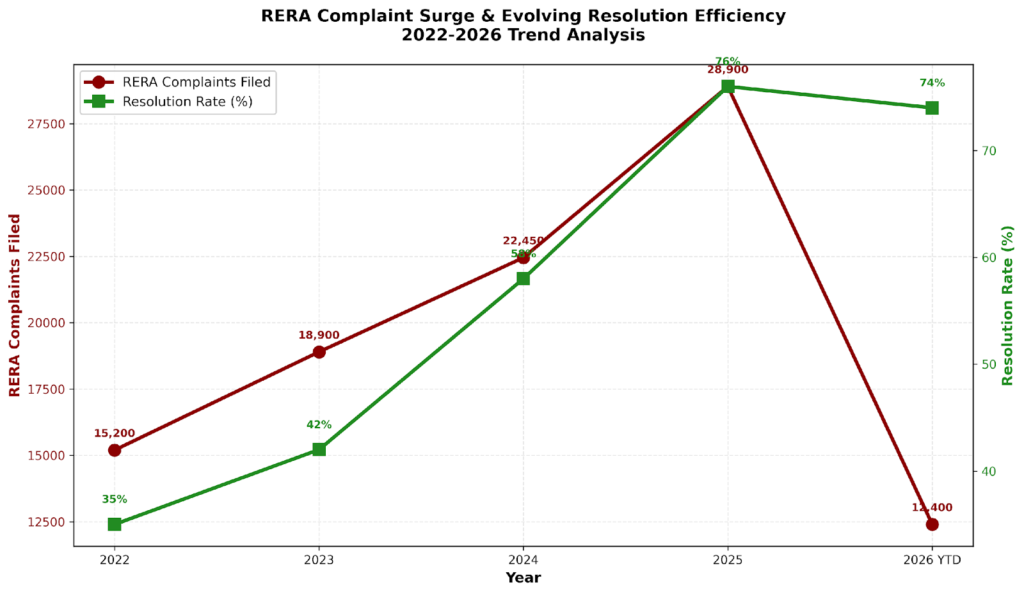
For the non-resident Indian with $500,000 to $5 million earmarked for property investment, India’s real estate market presents compelling returns alongside unprecedented vulnerability. The past eighteen months have witnessed a 29% surge in RERA complaints nationally—28,900 in 2025 alone—with NRI investors accounting for an estimated 40% of significant real estate scam cases.
What distinguishes 2026 is not the emergence of new scams, but the sophistication of old ones: title forgeries now pair with notarized documents; power of attorney abuse exploits legitimate legal frameworks; ghost projects masquerade as RERA-registered developments.
The difference between safeguarding your capital and losing ₹10 crore hinges on three overlooked verification steps and one critical legal structure that 89% of NRI buyers neglect.
Key Statistics at a Glance
- • RERA complaints surged 90% from 2022 to 2025 (15,200 → 28,900)
- • NRI investors comprise 40% of significant fraud cases
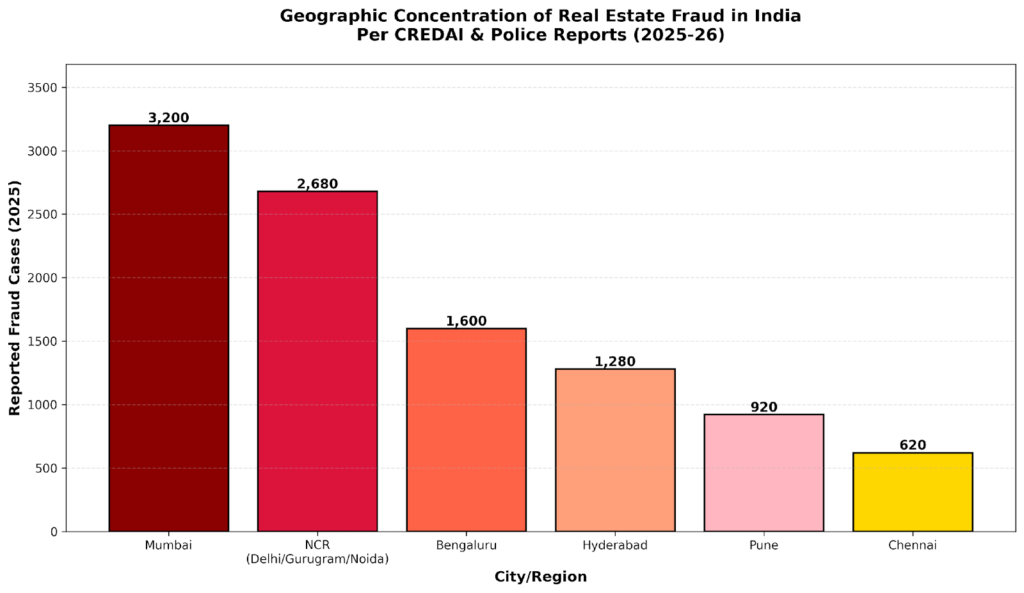
- • Mumbai accounts for 30% of reported real estate fraud cases
- • Average fraud loss per victim: ₹3-10 crore
- • Resolution rate improved from 35% (2022) to 76% (2025)
- • Title/document forgery comprises 28% of fraud cases
The Real Estate Scam Landscape In India: 2026 Reality
India’s real estate sector, projected to reach $5.8 trillion by 2047, attracts opportunists proportional to its opportunity. Between 2022 and 2025, RERA complaint filings more than doubled—from 15,200 to 28,900 annually—while resolution efficiency jumped from 35% to 76%. This paradox reveals an uncomfortable truth: buyers are increasingly aware. Fraudsters, responding in kind, have become subtler.
A ₹10.7 crore land scam in Gurugram involved no crude impersonation. Instead, a forged gift deed, registered at an actual sub-registrar’s office under a fictitious brother’s name, transferred ownership with apparent legal legitimacy. The victim—a New York-based businessman—discovered the fraud only when attempting to refinance the property.
The Ozone Urbana township fraud in Bengaluru wasn’t a vanishing act. The developer completed 49% of a 2012 project over thirteen years while systematically diverting ₹1,800 crore from homebuyer payments and circumventing Karnataka RERA’s 70% escrow mandate.

Fraud Type Distribution: Where Risk Concentrates
Title & Document Forgery (28%): The most prevalent category involving forged sale deeds, fabricated gift deeds, and counterfeit power of attorney documents registered through compromised sub-registrars.
General Power of Attorney Misuse (22%): A trusted employee or agent executes a perpetual GPA and sells the property without authorization. Often the POA predates the fraud by years.
Ghost Projects (18%): Pre-launch properties promoted aggressively with glossy renderings, celebrity endorsements, and promised timelines that never materialize. Funds disappear; projects stall indefinitely.
Fund Misappropriation & Diversion (15%): Escrow violations where developer funds are redirected to related entities or personal use instead of construction.
Benami Transactions (12%): Properties purchased in third-party names to obscure ownership or evade regulatory scrutiny.
Caretaker & Staff Fraud (5%): Trusted household employees exploit proximity to execute fraudulent transfers.
The Anatomy Of How NRI Fraud Unfolds
Case Study 1: The Forged Gift Deed (Gurugram, 2024)
The Setup: Anil K., a software executive based in Manhattan, inherited a 810 sq. meter plot in Sushant Lok 1, Gurugram. For three years, it remained undeveloped. A local property manager offered to handle the paperwork and market the asset.
The Mechanism: Working with associates, the manager fabricated a gift deed dated June 2024 showing Anil had transferred the land to his ‘brother’—a fictional relative. The document was registered at the Wazirabad sub-registrar’s office. Within weeks, the fictitious brother transferred the property to a builder and received ₹10.7 crore.
Why It Worked: Three failures aligned: (1) Anil hadn’t registered a limited, specific Power of Attorney; instead, his property manager held a general document enabling broad actions; (2) The property manager never updated the Encumbrance Certificate; (3) Sub-registrar office records weren’t cross-checked against the district’s property mutation register.
The Resolution: Eighteen months of litigation, ₹40 lakh in legal fees, and temporary title recovery. Permanent ownership remained contested.
The Lesson: A limited Special Power of Attorney would have made this fraud mechanically impossible. An Encumbrance Certificate check every quarter would have surfaced the fraudulent transfer within thirty days.
Case Study 2: The Ghost Project with Celebrity Endorsement (Hyderabad, 2021–Present)
The Setup: A 2.5-acre luxury development in Kondapur, promoted by a developer with a popular Tollywood actor as brand ambassador. The project promised 30 luxury villas with completion in 48 months.
The Mechanism: An NRI from Nigeria invested ₹3.6 crore for a 2,100 sq. yard plot. The agreement stipulated registration within one year. Five years later: the project remains unstarted. No Commencement Certificate was ever filed with RERA.
Why It Worked: Three failures: (1) The buyer didn’t verify RERA registration status directly; (2) The project had no Commencement Certificate; (3) Celebrity endorsement was mistaken for regulatory approval.
The Lesson: Verify RERA registration with the authority directly. Cross-check Commencement Certificate status. Never equate celebrity endorsement with regulatory compliance.
The 12-Point Verification Framework
1. RERA Registration Verification (Direct): Contact the relevant RERA authority directly—don’t rely on developer statements. Verify registration number, Commencement Certificate date, project timeline, and escrow account details.
2. Encumbrance Certificate (Three-Year Search): Obtain an EC dating back three years. This lists all legal claims, mortgages, liens, or transfers. This is your primary defense against title fraud.
3. Land Survey & Boundary Verification: Hire a licensed surveyor to physically inspect the property and compare on-ground reality with deed specifications.
4. Title Deed & Chain of Ownership: Verify the entire chain of ownership for at least fifteen years. Request link documents connecting each owner. Check for gaps or inconsistencies.
5. No Objection Certificate (NOC) Verification: Verify all NOCs from municipal, fire, pollution, electricity, water, and police authorities. Missing NOCs indicate the project isn’t legally cleared.
6. Occupancy Certificate & Building Completion: For ready properties, verify the Occupancy Certificate and Building Completion Certificate. Occupancy before OC is obtained violates municipal law.
7. Tax Paid Receipts & Property Mutation: Verify municipal and property tax receipts for the past five years. Ensure the property’s name has been updated in the municipal mutation register.
8. Power of Attorney (POA) Structuring – The Critical Step: Never grant a General or Perpetual POA. Grant a Special Power of Attorney limited to one transaction, with an explicit expiry date (3–6 months). Require quarterly written reports.
9. Financial Verification: Escrow Account & Fund Flow: Verify that buyer payments are deposited into an RERA-approved escrow account. Request monthly statements showing deposits and withdrawals linked to construction milestones.
10. Independent Legal Audit: Hire a real estate lawyer independent from the developer to conduct a thorough legal audit. This is non-negotiable for properties above ₹1 crore.
11. Registered Sale Deed (Not MOUs or Agreements): Insist on a registered sale deed as the final title document. Only a registered deed transfers legal ownership. Agreements and MOUs do not confer title.
12. Quarterly Ownership & Status Check (Ongoing): Even after purchase, conduct quarterly checks: updated EC search, tax payment status, and updates from your POA holder if one is in place.
The NRI Investor’s Checklist
- Avoid Perpetual POAs at All Costs. A Special Power of Attorney limited to one transaction, lasting 6 months, is your only safe instrument.
- Hire an Independent Real Estate Lawyer. Don’t use the developer’s recommended lawyer. Spend ₹1–₹2 lakh on dedicated legal counsel.
- Verify RERA Status Directly with the Authority. Check the state RERA portal or contact the office in writing, requesting confirmation of registration status.
- Encumbrance Certificates Are Your Insurance. Order a three-year EC search quarterly. This single document protects you from 70% of title fraud schemes.
- Request Registered Sale Deeds, Not Builder Agreements. A registered sale deed is the only legally binding proof of ownership.
FAQs
Conclusion
Real estate fraud in India is accelerating, but so is regulatory response. The increase in complaint resolution in 2025 versus 2024 signals that authorities are modernizing. The National Real Estate Policy 2025’s unified single-window clearance system aims to reduce project delays by 40%, potentially undermining one of fraudsters’ key tools—indefinite project stalling.
For the sophisticated NRI investor, this inflection point presents opportunity. Markets with transparent governance, strong RERA enforcement, and established legal frameworks are consolidating value. Emerging markets with improving regulatory infrastructure offer higher appreciation potential but require more diligent verification.
The winning formula combines three elements: (1) Jurisdictional selection—Prioritize markets with strong RERA enforcement; (2) Structural discipline—Never grant broad POAs; always insist on registered sale deeds; (3) Professional validation—Hire independent legal counsel.
The ₹5–₹10 lakh invested in legal audits and verification is fractional relative to the ₹1–₹10 crore at stake. Investors who treat this as insurance rather than expense are the ones who scale their India real estate portfolio without catastrophic loss.
For those ready to invest intelligently, India’s real estate remains a compelling vehicle for portfolio diversification and long-term wealth creation. The difference between success and devastating loss isn’t luck—it’s discipline.
YouTube Resources
Free Resources To Download
Real Estate Fraud Prevention: Key Points Summary